For years, direct-to-consumer brands have operated on a simple assumption: if you offer free shipping, customers will convert.
And for a time, that assumption held true. Free shipping removed one of the biggest sources of friction at checkout. It gave customers a reason to complete their purchase instead of hesitating or abandoning their cart. It quickly went from a competitive advantage to a baseline expectation.
But something has shifted.
Today, free shipping no longer differentiates your brand. It simply gets you into consideration. What happens next—whether a customer actually completes the purchase—depends on something else entirely:
How fast can you deliver?
The Expectation Reset
Customer expectations around delivery haven’t just evolved—they’ve been reset.
What was once acceptable—waiting five to seven business days—now feels slow. What once felt like a premium experience—two-day delivery—is increasingly viewed as standard. This shift didn’t happen in a vacuum. It was driven largely by companies like Amazon, which normalized fast, reliable delivery at scale and trained customers to expect it everywhere.
The result is a new reality for DTC brands: you are no longer competing on product and price alone. You are competing on experience—and delivery is a central part of that experience.
Free shipping might get a customer to click “checkout.” But delivery speed is what determines whether they follow through.
Where Conversion Is Won—or Lost
Once the cost of shipping is removed, the customer’s focus shifts. The question is no longer “How much will this cost me?” but “When will I get it?”
That question carries more weight than most brands realize.
A delivery estimate of five to seven days introduces doubt. It creates hesitation. The customer begins to wonder whether they can find the same product elsewhere—and get it sooner. In many cases, they don’t even consciously analyze the decision. They simply leave.
On the other hand, a fast, clearly communicated delivery window does something powerful. It reduces uncertainty. It builds confidence. It reassures the customer that the purchase will meet their expectations—not just in quality, but in timing.
This is why speed has such a direct impact on conversion rate. It doesn’t just improve logistics. It changes buying behavior.
The Hidden Cost of Slow Delivery
Most brands measure fulfillment performance in terms of cost per order. Fewer take the time to measure its impact on revenue.
But slow delivery shows up everywhere—often in ways that are easy to miss.
It shows up in abandoned carts that never convert, despite strong product-market fit and effective marketing. It shows up in rising customer acquisition costs, where more spend is required to generate the same number of purchases. It shows up in retention metrics, where customers fail to return after a disappointing delivery experience.
Individually, these issues can seem disconnected. Together, they point to a single underlying problem: the fulfillment experience isn’t meeting modern expectations.
And when that happens, growth suffers.
Why Speed Is So Hard to Fix
If the importance of delivery speed is so clear, why do so many brands struggle to improve it?
The answer lies in how most fulfillment systems are designed.
The majority of DTC brands rely on a single warehouse—either operated in-house or through a traditional 3PL. On the surface, this model is simple and cost-effective. In practice, it introduces a fundamental limitation: distance.
A single warehouse can only deliver quickly to customers who are geographically nearby. Everyone else is forced into longer transit times, higher shipping costs, or both. As a result, delivery speed becomes inconsistent, varying widely depending on where the customer is located.
To compensate, brands often turn to expedited shipping options. But this creates a new problem. Faster delivery becomes significantly more expensive, eroding margins and making it difficult to scale.
This is the tradeoff most brands find themselves stuck in: deliver quickly and pay for it, or protect margins and accept slower delivery.
Neither option is sustainable.
Rethinking Speed: It’s Not About Moving Faster
The instinctive way to think about delivery speed is to focus on how quickly orders are processed within the warehouse. But in reality, the biggest driver of delivery time isn’t how fast you pick and pack an order—it’s how far that order has to travel.
This is where the traditional model breaks down.
If inventory is located far from the customer, even the most efficient warehouse operations can’t overcome the constraints of distance. Orders still take days to arrive, and shipping costs remain high.
The only way to truly solve for speed is to rethink placement, not just process.
The Shift to Distributed Fulfillment
Modern fulfillment models address this problem by moving inventory closer to the customer.
Instead of relying on a single centralized warehouse, inventory is distributed across a network of locations. This allows brands to reach a larger percentage of their customers within one to two days using standard ground shipping.
The impact is significant.
Delivery becomes faster without relying on expensive air shipping. Costs decrease as shipping zones shrink. And perhaps most importantly, the customer experience becomes consistent—regardless of where the order is placed.
Speed is no longer a premium feature. It becomes the default.
Consistency at Scale
Of course, proximity alone isn’t enough. To deliver a fast and reliable experience at scale, fulfillment operations also need to be consistent.
This is where automation plays a critical role.
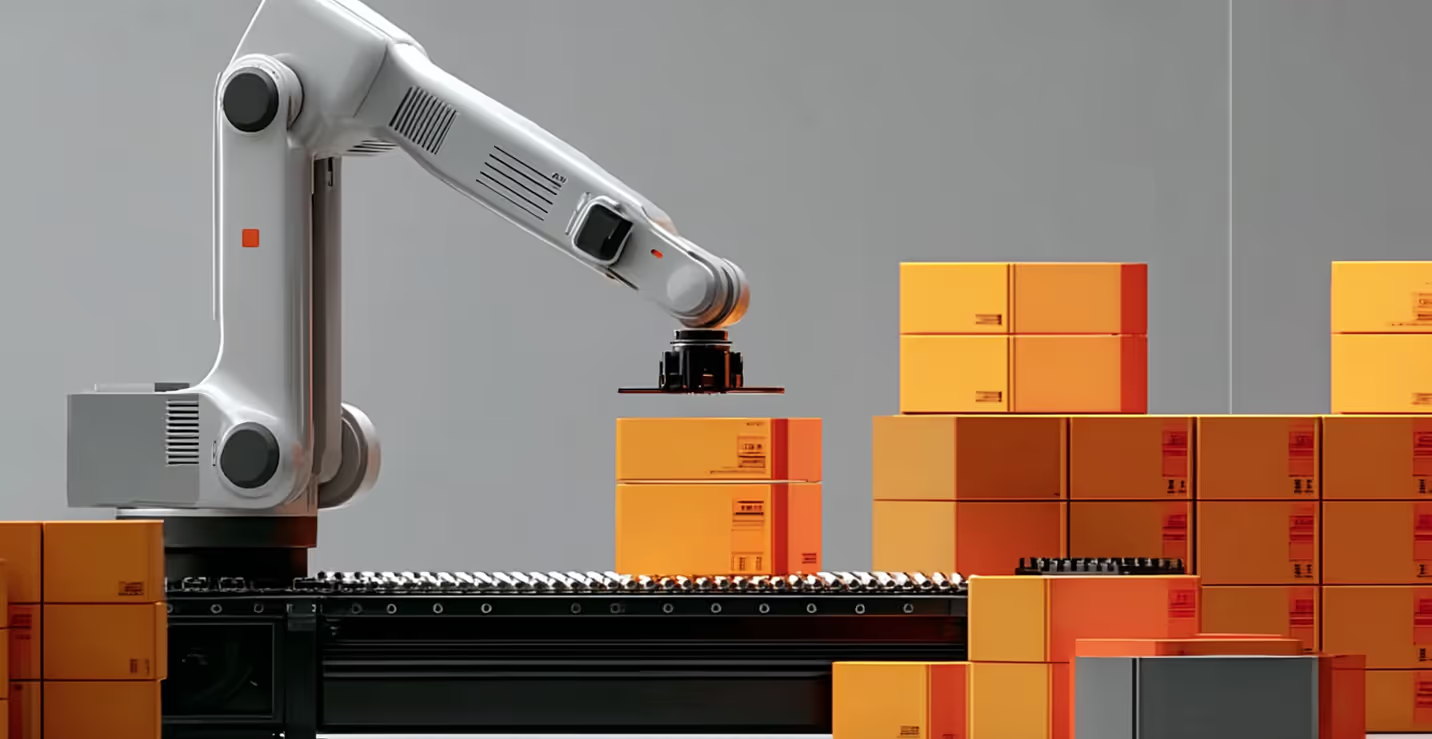
Robotic fulfillment systems eliminate many of the variables that slow down traditional warehouse operations. They operate continuously, without the constraints of shifts or labor shortages. They maintain high levels of accuracy, even during periods of peak demand. And they scale with volume, rather than struggling to keep up with it.
The result is a system where speed isn’t just possible—it’s predictable.
And in ecommerce, predictability is what builds trust.
From Cost Center to Growth Lever
When fulfillment is slow, it acts as a constraint on growth. It limits conversion, increases costs, and weakens the customer experience.
But when fulfillment is fast, reliable, and cost-efficient, it does the opposite.
It increases conversion rates by reducing friction at checkout. It supports higher average order values by giving customers confidence in the delivery experience. It drives repeat purchases by reinforcing trust after the first order.
In other words, fulfillment stops being a backend function.
It becomes a lever for growth.
The New Standard
Free shipping may have defined the last era of ecommerce, but it no longer defines the next one.
Today, customers expect more. They expect speed. They expect reliability. And they make purchasing decisions based on both.
For DTC brands, this creates a clear challenge—and an opportunity.
Those who continue to treat fulfillment as a cost center will struggle to keep up. Those who recognize its impact on revenue, and invest accordingly, will have a meaningful advantage.
Because in today’s market, winning the sale isn’t just about what you sell.
It’s about how fast you can deliver it.
If you want to see how fast, distributed fulfillment can increase conversion and reduce your shipping costs, it’s worth taking a closer look.
Talk to a Cytronic fulfillment specialist to understand how a robotic, distributed network can help you deliver faster—without sacrificing margins.